February 7, 2026, is expected to mark the end of the Presidential Transitional Council (CPT). As this deadline approaches, one conclusion is unavoidable: the transition has failed to stabilize the country, either in terms of security or institutional governance. Haiti remains without elected officials, and the idea of organizing a presidential election in the near future is gaining traction within the CPT.
This scenario, presented as a way to restore authority at the top of the state, raises serious concerns. The country has never been more fragmented, and holding a presidential election under current conditions appears highly uncertain. Historically, presidential elections in Haiti have often been followed by disputes, even when results seemed clear. Low voter turnout or perceived irregularities have repeatedly fueled debates over the legitimacy of the head of state.
Today, the environment is even more unfavorable. More than 90 percent of the capital and its metropolitan area are under the control of armed groups. Artibonite, one of the country’s most populous departments, is also experiencing a significant deterioration in security. As a result, a large portion of the population would effectively be excluded from the electoral process, and a president elected under such conditions would likely face immediate challenges to their legitimacy.
In this context, an alternative deserves serious consideration: the reestablishment—albeit partial—of Haiti’s Parliament. Since 2018, the country has operated within a pronounced institutional vacuum, without a legislature capable of balancing executive power or structuring national debate. Even a reduced Parliament could help restore a constitutional framework to the transition.
Admittedly, organizing legislative elections presents challenges similar to those of a presidential vote. Certain constituencies—particularly in the West, Center, and Artibonite departments—would likely be unable to participate due to insecurity. This would require accepting the idea of a truncated Parliament, composed only of representatives elected in areas where voting can take place without major constraints.
Under such a scenario, the National Assembly could consist of approximately 21 senators and between 82 and 92 representatives*, depending on developments on the ground. While far from ideal, this configuration would remain broadly representative. The 2015 legislative elections demonstrated the diversity of Haiti’s political landscape, with 21 parties or political groupings represented in Parliament. It is reasonable to expect that a reduced assembly would still reflect a plurality of viewpoints.
In municipalities not directly affected by violence, local elections could also be held, allowing the country to regain more than 200 elected representatives. This would help restore a minimum level of institutional structure and provide clearer mandates for those in government.
Within this framework, a president elected by the National Assembly and a prime minister approved by Parliament would enjoy stronger procedural legitimacy than leaders appointed through political arrangements or international pressure, as has been the case in recent years.
Several countries have held elections during periods of acute crisis, sometimes in the midst of armed conflict. Haiti, despite the particular challenges it faces, could draw lessons from these experiences to move toward a gradual rebuilding of its institutions.
At a time when quick fixes are tempting, it is worth recalling that lasting stability is often achieved through the patient and methodical restoration of democratic structures. For Haiti, that reconstruction could begin with Parliament.
D. Alain Menelas
*Certain areas would need to be excluded from the process, particularly the three departments most severely affected by violence. Specifically:
7 constituencies in Artibonite (including Dessalines and Saint-Marc).
14 constituencies in the West (including Port-au-Prince and Croix-des-Bouquets),
6 constituencies in the Center (including Mirebalais and Lascahobas),
Le 7 février 2026 doit marquer la fin du Conseil présidentiel de transition (CPT). À l’approche de cette échéance, un constat s’impose : la transition n’a pas permis de stabiliser le pays, ni sur le plan sécuritaire ni sur le plan institutionnel. Haïti demeure sans élus, et l’idée d’organiser prochainement une élection présidentielle gagne du terrain au sein du CPT.
Ce scénario, présenté comme un moyen de restaurer une autorité au sommet de l’État, soulève pourtant d’importantes interrogations. Le pays n’a jamais été aussi fragmenté, et la tenue d’un scrutin présidentiel dans les conditions actuelles apparaît particulièrement incertaine. Historiquement, les élections présidentielles en Haïti ont souvent donné lieu à des contestations, même lorsque les résultats semblaient clairs. La faible participation ou les irrégularités perçues ont régulièrement alimenté des débats sur la légitimité du chef de l’État.
Aujourd’hui, l’environnement est encore plus défavorable. Plus de 90 % de la capitale et de sa zone métropolitaine sont sous le contrôle de groupes armés. L’Artibonite, l’un des départements les plus peuplés du pays, connaît également une dégradation importante de la sécurité. Une large partie de la population serait de fait exclue d’un tel scrutin, et un président élu dans ces conditions risquerait d’être contesté dès son entrée en fonction.
Dans ce contexte, une alternative mérite d’être examinée : la reconstitution, même partielle, du Parlement haïtien. Depuis 2018, le pays évolue dans un vide institutionnel marqué, sans législature pour équilibrer le pouvoir exécutif ou porter les débats nationaux. Un Parlement, même réduit, pourrait redonner un cadre constitutionnel à la transition.
Bien sûr, organiser des élections législatives pose les mêmes défis que pour une élection présidentielle. Certaines circonscriptions — notamment dans l’Ouest, le Centre et l’Artibonite — ne pourraient probablement pas participer en raison de l’insécurité. Il faudrait accepter l’idée d’un Parlement tronqué, composé uniquement de représentants élus dans les zones où le vote peut se dérouler sans contrainte majeure.
Par exemple, l’Assemblée nationale pourrait compter environ 21 sénateurs et entre 82 et 92 députés*, selon l’évolution de la situation sur le terrain. Une telle configuration ne serait pas idéale, mais elle resterait représentative. Les dernières élections législatives de 2015 avaient montré la diversité du paysage politique haïtien, avec 21 partis ou regroupements présents au Parlement. On peut raisonnablement penser qu’une assemblée réduite refléterait encore une pluralité de points de vue.
Dans les communes non touchées par la violence, des élections municipales pourraient également être organisées, permettant au pays de retrouver plus de 200 représentants élus. Cela contribuerait à rétablir un minimum d’encadrement institutionnel et à donner un mandat clair à ceux qui gouvernent.
Dans ce schéma, un président élu par l’Assemblée nationale et un Premier ministre approuvé par le Parlement disposeraient d’une légitimité procédurale plus solide que des dirigeants désignés par accord politique ou pression internationale, comme c’est le cas depuis plusieurs années.
Plusieurs pays ont organisé des élections en période de crise aiguë, parfois en plein conflit. Haïti, malgré les défis spécifiques auxquels il fait face, pourrait s’inspirer de ces expériences pour avancer vers une reconstruction progressive de ses institutions.
Dans un moment où la tentation est grande de chercher des solutions rapides, il est utile de rappeler que la stabilité durable passe souvent par le rétablissement patient et méthodique des structures démocratiques. Pour Haïti, cette reconstruction pourrait commencer par un Parlement.
D. Alain Menelas
* Certaines zones devraient être exclues du processus, notamment les trois départements frappés de plein fouet par la violence. Concrètement :
14 de l’Ouest (Port-au-Prince, Croix-des-Bouquets)
6 circonscriptions du Centre (dont Mirebalais et Lascahobas),
Le 31 décembre 2009, il était possible de croire que l’on vivait l’un des meilleurs moments de l’histoire politique haïtienne. Le pays avait récemment vécu des moments difficiles, mais il existait un sentiment que la nation écrivait un nouveau chapitre de son histoire. Février 1986 a osé promettre à chaque citoyen haïtien quelque chose que même la révolution haïtienne n’avait pas accompli : que chaque individu puisse avoir son mot à dire sur le destin de son pays. La sagesse d’une telle trajectoire n’était pas évidente pour tous ; un ancien ministre des Finances et professeur d’université a souligné en 2020, que lorsque Haïti avait choisi la démocratie, peu de pays de la région avaient choisi ce modèle. Si cette déclaration était censée faire écho à la conviction qu’Haïti échouait en matière de démocratie parce que le pays n’était pas prêt à l’adopter, elle souligne également l’audace d’un tel choix 24 ans plus tôt. Ce discours peut également être la preuve que le principal obstacle à la démocratie haïtienne a été ses élites. Dans le débat sur la démocratie haïtienne, une question revient souvent : comment peut-on permettre à une majorité d’illettrés qui ne comprennent rien aux affaires du monde d’avoir leur mot à dire sur le destin du pays ? Cette question est avant tout une critique du suffrage universel direct. Ces inquiétudes et ces questions négligent une vérité flagrante : si les décisions de l’État doivent affecter tout le monde, y compris les Haïtiens les plus illettrés, toute communauté devrait participer à la prise de décision. Le déni de la démocratie haïtienne en tant que système de gouvernement approprié pour les simples Haïtiens, et l’idée qu’un dictateur serait plus adapté, sont avant tout un rejet du concept selon lequel tout le monde devrait avoir voix au chapitre. Cependant, malgré la noblesse de l’approche démocratique, il est clair que les espoirs nés de la promesse de 1986 ne se sont pas concrétisés ; la pauvreté généralisée, le désespoir, l’effondrement de l’appareil de sécurité et l’échec de l’État lui-même ont souvent donné lieu à des arguments en faveur d’une approche plus brutale de la prise de décision. Le problème avec cet argument est qu’Haïti a déjà essayé cette approche auparavant. Elle n’a pas non plus tenu ses promesses, ce qui conduisit à la chute de cette dictature immonde, le matin fatidique du 7 février 1986.
De l’autorité et des institutions
Le 18 mai 2024, la majeure partie de la capitale haïtienne et plusieurs régions du pays étaient sous le contrôle ou sous la menace de bandes armées. Quelques semaines auparavant, la principale prison du pays avait été vidée après une attaque de groupes armés, preuve ultime que l’État haïtien, ainsi que ses forces de sécurité, s’étaient complètement effondrés. Il était clair qu’à moins que la communauté internationale n’intervienne, les forces des ténèbres ne connaîtraient aucune limite. On pourrait se demander : comment un pays passe-t-il d’un dictateur brutal contrôlant chaque centimètre du pays à un état d’anarchie généralisée ? Lors de son départ, le dictateur confia le pouvoir aux forces armées d’Haïti. Pourtant, ces forces armées ont commis une erreur fondamentale : une incapacité à distinguer l’autorité de l’État de la leur. L’armée était incapable d’imager un Haïti en paix sans un général à la barre. Cette approche a conduit à des massacres, des coups d’État contre des officiers de l’armée et contre les dirigeants élus et à la cohabitation avec des escadrons de la mort paramilitaires. Au moment de la démobilisation des forces armées en 1995, il était clair que l’armée ne voulait pas exister dans un Haïti démocratique. L’une des plus anciennes institutions du pays a disparu parce qu’elle ne pouvait pas exister dans une nation plus juste et plus moderne. Certains experts de la droite qui aiment imputer l’échec de l’appareil de sécurité à la démobilisation de l’armée ont tendance à ignorer ce fait fondamental : l’armée ne s’intéressait plus à la sécurité de l’État. Elle voulait être l’État à tout prix. Dans un Haïti qui souhaitait donner une voix à tous ses fils et filles, de telles forces armées ne pouvaient pas exister.
La disparition de l’armée n’était que le symptôme d’un mal plus grave : la réticence du pays à construire des institutions fiables et fortes. Les forces de police qui ont remplacé l’armée et les institutions politiques conçues pour être l’épine dorsale du nouvel État haïtien se sont enlisées dans un réseau de corruption. En 2021, lors d’une manifestation pour la création d’un syndicat de police, la policière en charge affirma qu’elle piétinerait quiconque tenterait de bloquer leur demande ; un autre exemple de forces de sécurité menaçant l’État et l’ordre qu’elles étaient censées protéger. Le professeur Manigat, ancien président destitué par l’armée, expliquerait ainsi les démocrates d’Haïti : « Le mérite de Duvalier est qu’il a eu le courage d’être un dictateur, mais maintenant nous prétendons avoir des démocrates, mais ce sont les mêmes approches et les mêmes pratiques. » En affaiblissant les institutions, les dirigeants du pays pensaient pouvoir les contrôler. Cela a conduit à l’effondrement inévitable de l’État-nation haïtien dans son ensemble, forçant le pays à expérimenter des voies inconstitutionnelles et à quémander l’aide des institutions internationales. Haïti a créé son propre chaos, a demandé de l’aide et s’est demandé pourquoi l’aide n’arriverait pas assez vite. 2024 est le plus grand exemple d’un pays sabotant le plus grand moment de son histoire.
L’espoir et la diaspora
Réunie dans un restaurant de Floride, la diaspora Haïtienne parlait Haïti. Le groupe croit encore à un changement pour le mieux en Haïti et que la diaspora jouera un rôle important dans ce processus. C’était un spectacle puissant d’assister à cette explosion d’espoir alors que des milliers d’Haïtiens étaient morts, d’innombrables femmes violées, des familles détruites et l’État en ruine. Il n’est peut-être pas très difficile d’avoir de l’espoir quand on n’a pas à faire face à la réalité des armes à feu. Le groupe a pris le temps de souligner que certains étrangers profitaient des misères d’Haïti, et avec raison. On a moins insisté sur le fait que toutes les armes qui affluaient vers Haïti étaient très probablement facilitées par des membres de la communauté du sud de la Floride. Les réalités de la diaspora haïtienne ne peuvent pas se limiter aux actions de quelques-uns ; bien que la communauté compte parmi elle des trafiquants d’armes, elle compte aussi des citoyens honnêtes qui apportent et apporteront des changements significatifs à leur communauté. Mais l’erreur fondamentale de la diaspora est la même que celle des Haïtiens vivant en Haïti : rester les bras croisés et parfois applaudir pendant que les institutions du pays étaient en train d’être anéanties. Aujourd’hui, le seul espoir des Haïtiens repose sur le peuple américain et ses dirigeants ; un refus d’aider Haïti aurait sûrement entraîné l’émergence d’un chef de gang comme prochain dirigeant du pays. Le dernier effort majeur des gangs a été de prendre le siège de la présidence. Malgré l’arrivée future d’une force de police internationale en Haïti, il n’est peut-être pas faux de penser qu’Haïti en tant qu’État-nation vit sa dernière chance. Dans vingt-quatre ans, il n’y aura peut-être plus d’État haïtien malgré les espoirs de la diaspora. Un changement du paysage politique Américain ou l’émergence d’une superpuissance non occidentale pourraient encourager les fauteurs de troubles du futur à prendre le contrôle des ruines des institutions haïtiennes. Ce jour-là, les Haïtiens regretteront peut-être de ne pas avoir conservé un dictateur, une armée nationale égoïste, voire même leurs dirigeants démocratiques médiocres. La vérité demeurera qu’Haïti s’est effondrée politiquement au meilleur moment de son histoire, celui où la nation désirait construire un pays avec la voix de tous ses fils et filles. Ses élites, qu’elles n’aient jamais cru à la démocratie haïtienne ou qu’elles aient eu des visées égoïstes, devront comprendre que c’est sur les ruines des institutions haïtiennes que la grande promesse de 1986 a été gâchée.
On December 31st, 2009, it was not difficult to believe that one was living through the greatest moments of Haitian political history. The country had recently gone through its fair share of troubles, but there was a sense that the nation was writing a new chapter in its history. February 1986 dared to promise every single Haitian citizen something that even the Haitian revolution did not: a say in the destiny of their country. The wisdom of such a trajectory was not evident to all; a former minister of finance and university professor pointed out in 2020 that when Haiti chose democracy, few countries in the region had done so. While his statement was meant to echo the belief that Haiti was failing at democracy because the country was not ready to embrace it, it also highlights the audacity of such a choice 24 years prior. It may also be proof that the main barriers to Haitian democracy have been its elites. In the debate on Haitian democracy, a question often came up: how does one allow a majority of illiterate souls with no understanding of the affairs of the world to have a say in the destiny of the country? This question is, above all, a criticism of direct universal suffrage. These worries and questions fail to consider a blatant truth: if the decisions of the state are going to affect everyone, including the most illiterate Haitian, then everybody should participate in the decision-making. The denial of Haitian democracy as an inappropriate system of government for the simplistic Haitian, and the idea that a dictator would be more suitable, is above all a rejection of the concept that everybody should have a voice. However, despite the nobility of the democratic approach, it is clear that the hopes stemming from the promise of 1986 did not materialize; widespread poverty, desperation, the crumbling of the security apparatus, and the failure of the state itself have often created arguments for a more brutal approach to decision-making. The issue with that argument is that Haiti tried it before; it failed to deliver too, which led to the demise of the filthy dictatorship on a fateful morning of February 7th, 1986.
Of Authority and Institutions
On May 18th 2024, most of the Haitian capital and several parts of the country were controlled or under threat of armed gangs. A few weeks prior, the main prison of the country was emptied after an attack from armed groups, providing the ultimate proof that the Haitian state, along with its security forces, had completely crumbled. It was clear that unless the international community intervened, there would be no end to the reach of the forces of darkness. One could ask; how does a country go from a brutal dictator controlling every inch of the country to a generalized state of lawlessness? When the dictator left, he entrusted power to the armed forces of Haiti. Yet these armed forces went on to make a fundamental mistake: an inability to distinguish the state’s authority from their own. The army could only see an orderly Haiti with its generals at the helm. This led to massacres, coups against their own and against elected leaders and cohabitation with paramilitary death squads. By the time the armed forces were demobilized in 1995, it was clear that the army was unwilling to exist in a democratic Haiti. One of the oldest institutions in the country vanished because it could not exist in a fairer and more modern nation. Some right-wing experts who love to blame the failure of the security apparatus on the demobilization of the army tend to ignore this basic fact: the army was no longer interested in securing the state. It wanted to be the state at any cost. In a Haiti that desired to give a voice to all its sons and daughters, such armed forces could not exist.
The disappearance of the army was but a symptom of a greater illness: the country’s unwillingness to build reliable and strong institutions. The police forces that replaced the army and the political institutions designed to be the backbone of the new Haitian state got mired in a web of corruption. In 2021, during a protest for the creation of a police syndicate, the police officer in charge claimed she would trample over anyone trying to block their request. It was yet another example of security forces threatening the state and the order they were created to protect. Professor Manigat, a former president deposed by the army, would explain Haiti’s democrats thus: “The merit of Duvalier is that he had the courage to be a dictator, but now we claim to have democrats, but it is the same approaches and practices as Duvalier.” By weakening institutions, the leaders of the country thought they could control them. This led to the inevitable crumbling of the Haitian nation-state as a whole, leaving the country to experiment with unconstitutional paths and beg for help from international institutions. Haiti created its own chaos, asked for help, and wondered why the help would not come fast enough. 2024 became the greatest example of a country sabotaging and fumbling the greatest moment of its history.
Hope and the Diaspora
During an event honoring one of its members, the Haitian diaspora gathered some of its prominent constituents in a restaurant in South Florida. The group agreed that there was still hope for change in Haiti and that the diaspora would play an important part in it. It was a powerful sight to witness this burst of hopefulness when thousands of Haitians had died, countless women raped, families destroyed, and the state in shambles. Then came the realization that it may not be very difficult to be hopeful when one does not have to face the reality of life-shattering bullets. Time was taken to point out that some foreign groups were profiting from the miseries of Haiti, and this is true. Less emphasis was put on the fact that all the guns flowing to Haiti were very likely facilitated by members of the South Floridian community. The realities of the Haitian diaspora cannot be limited to the actions of a few; while they produced gun runners, they count within their midst some upstanding citizens who are bringing and will bring significant change to their community. But the fundamental mistake of the diaspora is the same that Haitians living in Haiti made: standing-by and sometimes applauding while the institutions of the country were being obliterated. Today, the only hope for Haitians lies with the American people and its leaders; an unwillingness to help Haiti would have surely brought the emergence of a gang leader as the next leader of the country. The gangs’ last major effort was to take the seat of the presidency. Despite the future arrival of an international police force to Haiti, it may not be wrong to think that Haiti as a nation-state is getting its last chance. Twenty-four years from now, there may no longer be a Haitian state despite the diaspora’s hopes. A changing political landscape in the United States or the emergence of a non-Western superpower could embolden the troublemakers of the future to take-over the ruins of Haitian institutions. On that day, Haitians may wish they had kept a dictator, a self-serving national army, or even their mediocre democratic leaders. The truth will remain that Haiti crumbled politically at the best time in its history; the time when it desired to build a country with the voice of all its sons and daughters. Its elites, whether they never believed in Haitian democracy or had self-serving designs, will have to understand that it is on the ruins of the Haitian institutions that the great promise of 1986 was forfeited.
This case study intends to illustrate issues that health-based organizations face in Haiti. It does not intend to provide a blueprint as to how organization should be run. As with all case studies, it does not provide answers but poses questions that can be tackled by interested parties. This document looks at the management aspects of health organizations rather than an in-depth review of the medical services rendered by a mobile clinic. This case study focuses on the operational and project management aspects of health-based organizations.
D. Alain Menelas
C.Paribus Management
Rethinking Mobile Health Clinics in Haiti
Wasted Resources?
It is 4 o’clock at the Toussaint Louverture international airport in Port-au-Prince and Ms. Djenny Pierre is waiting for the airplane that will take her back to Massachusetts. As always, her plane is late and she can’t help but reflect about this trip to Haiti. Ms. Pierre is the director and founder of Banmsantee, a health organization based in Massachusetts and Haiti. Currently, the operations of Banmsantee mostly take place in Massachusetts however Ms. Pierre travels to Haiti often to organize mobile clinics and supervise the completion of her clinic in Les Cayes, a bustling city in the South department.
Ms. Pierre’s flight back to the United States was supposed to be a joyful one. This is the second mobile clinic her organization led. In December 2020, Banmsantee held a free clinic at a Christian church in Les Cayes. On that occasion, she was able to serve 50 people from 7:30 am to 1:30 pm. For this trip, she had scheduled three days of mobile clinics during the month of May for Mother’s Day. Banmsantee expected to serve at least 50 people a day over two days but barely served 50 over the two days combined (See exhibit 1).
Exhibit 1. Mobile clinics and number of patients served
Date
Number of days
Location
Number of patients
December 24, 2020
1
Christian church
50 patients
May 29-30th,2020
2
Local school
50 patients
Sitting at the airport, Ms. Pierre believes that it is unfortunate that in a country were most people lack access to health services, her organization was not able to reach more patients. Looking at the tarmac through the large windows, she reflects on the main reason why attendance was so low; her collaborators failed to spread the word and as a result few people knew that she was having a free clinic. How can she make sure that this does not happen again? She wondered, how could she serve 100 people or more a day during her next clinic. Her flight back to Boston was going to be a long one.
Background
Haiti is a country in the Caribbean where 11 million people live. The country shares the island of Hispaniola with the Dominican Republic. Haiti is the poorest country in the western hemisphere with close to 60% of its population living under the poverty line. In 2019, the GDP per capita of the country was estimated to be about U$ 2,905. In 2018, there were 0.23 physicians for every 1000 individuals[1]. In 2010, a devastating earthquake killed about 250,000 Haitians and put significant pressure on already meager health infrastructures. Despite significant international support, access to basic health services remains a challenge especially in rural areas where such services are quasi non-existent. 23 % of the population have access to primary care of good quality; that includes 5% of the rural population.[2]
Mobile clinics in Haiti
Every month, local and international organizations hold mobile clinics in Haiti. A mobile clinic is usually held at a non-permanent location for one or a few days. Many mobile clinics tend to take place in rural areas because access to health services is scarcer in these areas. Health organizations know that they can have their greatest impact in those healthcare deserts.
Mobile clinics also take place in urban areas despite the presence of more health institutions. Due to widespread poverty, individuals tend to avoid hospitals and clinics unless they are facing serious health conditions. By holding free mobile clinics, private organizations can attract people who suffer from minor illnesses. This is important because minor illnesses can often lead to more serious concerns. Ms. Pierre explains that the people who attend the clinics will complain of a backache, headache or a neck pain only to find out that they suffer from hypertension. Others who experience drastic weight loss take advantage of the glucose test and find out that they suffer from diabetes. In fact, most of the patients who attend Ms. Pierre’s mobile clinics have diabetes concerns although the organization is open to all regardless of their ailments.
For a population that lacks access to basic healthcare due to economic and/or geographic constraints, mobile clinics play an important role in preventing easily treatable diseases from developing into more serious health conditions. In the case of diabetes, Ms. Pierre claims that people who suffer from this disease will need to be educated in order to manage it well. Mobile clinics can provide this service free of charge to patients.
The Christmas day clinic
On Christmas day of 2020, Banmsantee held a mobile clinic at one of the most popular Christian churches in the city of Les Cayes. 50 people attended from 7:30 am to 1:30 pm. By the time the organization closed shop, there were no more patients to see. Most of the patients were members of the church. For that particular clinic, Banmsantee was able to gather a team of 12 volunteers that consisted of doctors, resident doctors and nurses. (See exhibit 2)
Exhibit 2. Staff for the Christmas Day Clinic
Title
Quantity
Doctor
2
Resident Doctor
6
Nurse
4
All in all, with 12 volunteers and 6 hours of work (36 staff hours), Banmsantee was able to tend to 50 patients; that is about 1.39 patient for every staff hour. In other words, less than 2 patients per staff hour were served during that clinic.
Planning the Mother’s Day clinic.
Banmsantee’s goal was to organize another mobile clinic after the one that took place on Christmas day. The dates of May 28, 29, 30th, 2021 were chosen to conduct the new clinic; that weekend in May coincided with Haitian Mother’s Day and the goal was to serve mostly women. Banmsantee wanted to hold the clinic on a soccer field in anticipation of greater attendance. To increase her organization’s capacity, Ms. Pierre partnered up with SOMI, a local organization involved in general prevention, HIV support and helps with orphans. This partnership meant that 25 health professionals were available for the three days of the clinic (see exhibit 3).
Exhibit 3. Staff for the Mother’s Day clinic
Title
Quantity
Doctor
2
Nurses
6
Resident Nurses
17
The new dates were announced in December 2020. Banmsantee purchased a megaphone and the plan was to hire a person to ride around the city and share the news of the upcoming clinic a few weeks before the event. Plans to advertise the event over the radio were also drawn up.
The Mother’s Day clinic
6 weeks before to the start of the clinic, it became clear that the event would not take place on a soccer field. The main soccer venue was hosting a game during that weekend. An alternate field was available to host for a U$ 300 fee over three days. The mobile clinics are free and not revenue generating. Banmsantee could not bear the extra cost. The organization ultimately secured 4 classrooms in a major school conveniently located in the city. Unfortunately, because school was in session on Friday, Banmsantee could only use the rooms on Saturday the 29th and Sunday the 30th (see exhibit 4).
The plan to communicate the event throughout the city did not work out either. The potential riders with the megaphone asked for too much money and that plan was no longer viable. The radio announcement could not be recorded until the location was secured. The event was starting on the 29th and the radio advertisement went out on Thursday the 27th. Attendance during the event was so low that the nurses had to recruit patients throughout the day. The event, originally designed for women, served a lot of men who were lured-in by the promise of free condoms. Ms. Pierre, despite her disappointment, believed that her team was able to save the day by getting the nurses to recruit the days of the mobile clinic. Ultimately, Banmsantee served 50 people over two days with an improvised strategy, without it the numbers could have been extremely low. For 6 hours of work per day (2 days) and 25 health care professionals (300 Staff hours), Banmsantee served 50 people; that is the equivalent of tending to 0.17 people per staff hour. In other words, Banmsantee was able to serve 1 patient per 6 staff hours (see exhibit 5).
Exhibit 4. Plan vs Actual
Plan
Actual
Staff
25
25
Location
Soccer field
High school
Advertisement
3 months before event
2 days before event
Days of service
3
2
Attendance expectations
More than 50 a day
About 25 per day
Exhibit 5. Staff and performance during Christmas day vs mother’ day.
Christmas day
Mother’s Day
Staff
12
25
Days of service
1
2
Hours per day
6
6
Number of patients served per day
50
50
Patients served per staff hours
1.39
0.17
Operations during the Mother’s Day clinic
For the Mother’s Day clinic, Banmsantee was given access to 4 classrooms that were rearranged to fit the organization’s needs (see exhibit 6).
Exhibit 6. Floor plan and Pathway
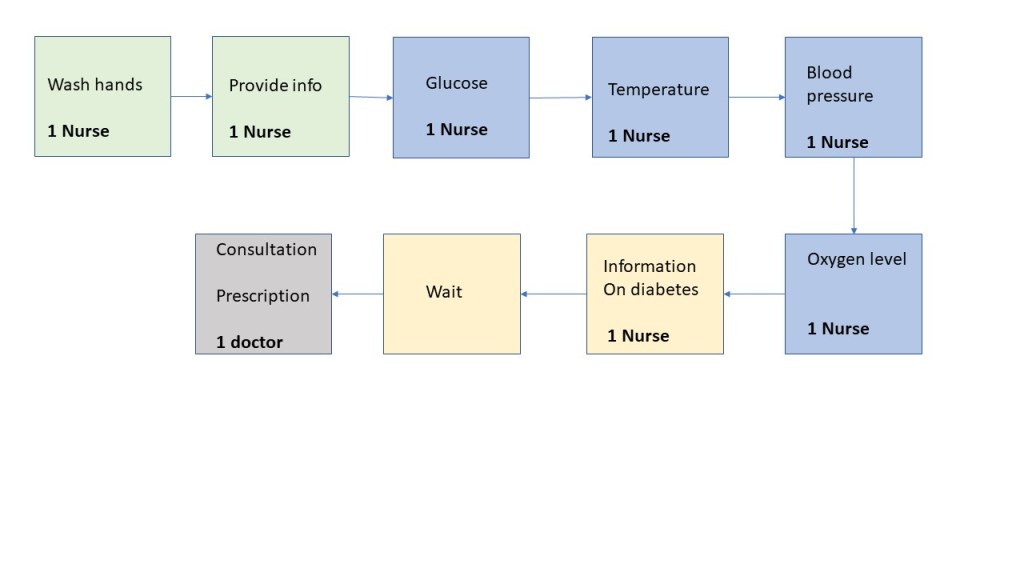
Patients are greeted by two nurses who complete the intake process. The nurses ask patients to wash their hands and respond to a series of questions to collect demographic information. The data is written down on a paper held by the patient throughout their visit. Patients move on to the check-up room where measurements for oxygen levels, blood pressure, glucose levels and temperature are taken. Patients are then directed to the next room that serves as a learning room, where they receive basic and essential information about managing diabetes, HIV and how to wash one’s hand properly. This room also serves as a waiting room until a doctor becomes available. Finally, patients proceed to a consultation room where they are screened by a doctor who gives advice and prescribes medication if need be (see exhibit 7).
Exhibit 7. The patient’s pathway and staff used
Opportunities and Challenges
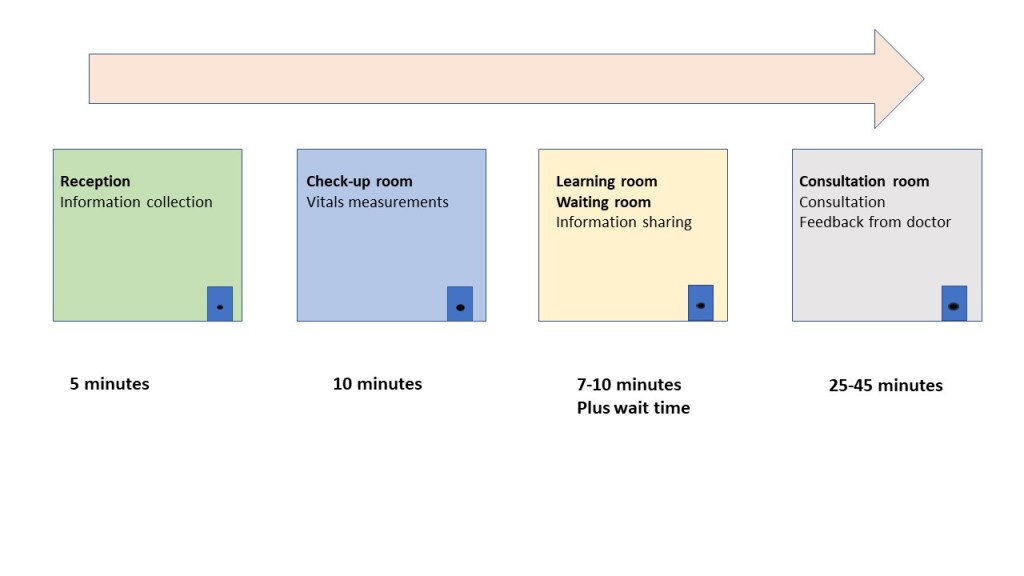
The challenges that arose during the Mother’s Day mobile clinic are circumstantial and significantly impacted the original plans. Upon reflection, Ms. Pierre understands that there are opportunities for Banmsantee to improve operationally and in-turn service a greater number of patients. For example, two different nurses are not needed for hand washing and intake. One nurse could measure glucose, temperature, blood pressure and oxygen level in the same amount of time. The only reason measurements were taken by 4 different nurses was because of low attendance and the need to occupy some nurses. Banmsantee would also like to provide the information session after the consultation with the doctor if possible. The organization also provides free medical kits during these information sessions. In order to achieve that, the wait time between the check-up room and the consultation room would have to be significantly lower. Another issue is the time spent with the doctors; patients will spend between 25 to 45 minutes with the doctor. Some patients spend a lot more time talking to the doctor and Ms. Pierre believes that consultations can be kept at 30 minutes (see Exhibit 8).
Exhibit 8. Patient pathway and timeline
While many Haitians do not have access to medical services, there are many local doctors and nurses who remain underemployed. Ms. Pierre trusts that there is a significant opportunity to hire them occasionally for mobile clinics. So far, all the clinics have been done with local volunteers. She believes that sooner or later, Banmsantee will have to provide a stipend to incentivize involvement and sustain the mobile clinic offerings.
There are also sustainability challenges to keeping up the mobile clinics; the organization needs financial contributions in order to hold the clinics. The service may be free to patients but materials have to be paid for. In addition to buying lancets for glucose testing, the organization provides kits that carry hygienic pads, underwear and condoms. Whether volunteers get paid or not, they are provided with a hot meal, snacks, water and juice during the days they work. The organization also buys medication that is given to patients free of charge. The question of the stipend for doctors and nurses will have to come up soon or later. In the Haitian system, a doctor gets paid twice the amount of a nurse; a stipend would have to reflect that. The main operational challenge is that doctors are needed to increase the capacity of mobile clinics. The reality is that physicians cost twice as much as nurse and are more difficult to come by for volunteering opportunities.
As she sits in the airplane, Ms. Pierre tells herself that she would have to significantly ameliorate her ability to get the word out. Especially if she wants to also conduct mobile clinics in the rural areas. Are there any lessons in communication she could learn from the Christmas day clinic? She also realizes that there is no need to have many idle nurses on site, even if they are volunteers; she could gain a lot by planning her staff needs. The organization wants to significantly increase the number of patients they serve during a mobile clinic by 100%; could she redesign her operations to reach that goal without significantly increase her cost? The organization will also have to ameliorate the quality and the delivery of the service that it provides; it will need to decrease wait time so patients can go about their day. Banmsantee may have to redesign their staff requirements to achieve that. This was going to be a long flight indeed.
Sur la base de la présence d’individus déféquant sur les plages des Cayes et de l’affirmation du candidat à la mairie (Fortuné) selon laquelle toutes les latrines devraient être remplacées par des toilettes à chasse d’eau, j’ai cherché à savoir s’il y avait un problème de toilettes dans la ville des Cayes. Pour cette étude, j’ai mené une enquête dans la ville en aout 2020, procédé à l’observation des données de dénombrement et de proportion, créé un graphique à barres pour le décompte des types de toilettes disponibles et effectué un test d’hypothèse sur la proportion de toilettes à chasse d’eau dans la population générale. J’ai également créé un graphique à barres et observé les données de dénombrement et de proportion avant de créer un test d’hypothèse sur la proportion de la population n’ayant pas accès aux toilettes. Enfin, j’ai créé un histogramme pour le nombre de personnes vivant dans un ménage et calculé la moyenne. J’ai également effectué un test d’hypothèse pour le nombre moyen de personnes dans chaque ménage. J’en suis venu à la conclusion qu’environ 41% de la population des Cayes ont accès à des toilettes avec chasse d’eau. Grâce à d’autres tests d’hypothèses, je suis en mesure de dire qu’environ 95% de la population des Cayes n’a aucun accès aux toilettes. Enfin, grâce au test d’hypothèse, je suis convaincu à 95% que le nombre réel de personnes composant un ménage aux Cayes est compris entre 4 et 5 (4,67).
Introduction
La ville des Cayes se situe dans le département du sud d’Haïti. J’estime qu’environ 92 387 personnes vivent dans la ville aujourd’hui. Dans la ville des Cayes, il n’est pas rare de voir des gens déféquer au bord de la plage. Aussi, en 2016, le futur maire des Cayes avait promis de remplacer toutes les latrines de la ville par des toilettes à chasse d’eau. Récemment, Haïti a fait face à une pandémie de choléra qui a tué des milliers de personnes, il est donc compréhensible que le sujet des toilettes modernes ait pris une place de premier plan dans les débats généraux. Ces deux constats m’ont conduit à remettre en question l’état des toilettes dans la ville des Cayes. Dans cet article, j’ai l’intention de savoir combien de personnes ont accès aux toilettes à chasse d’eau, combien de personnes ont accès aux toilettes en général et combien de personnes vivent en moyenne dans une maison aux Cayes.
Données et méthodes
Pour cette étude, je souhaitais un niveau de confiance de 95%, un écart type de 0,5 et une marge d’erreur (intervalle de confiance) de +/- 5%. Par conséquent, j’ai calculé la taille de l’échantillon en utilisant la formule suivante : Taille de l’échantillon requise = ((0,5) ² × (0,5) × (1-0,5)) / ((0,05) ²). Par conséquent, taille de l’échantillon requise = 385 répondants.
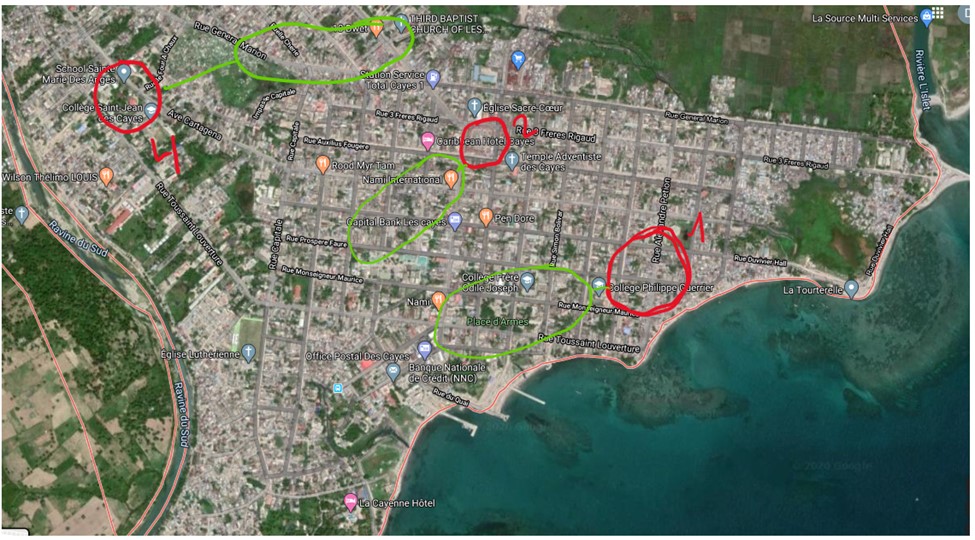
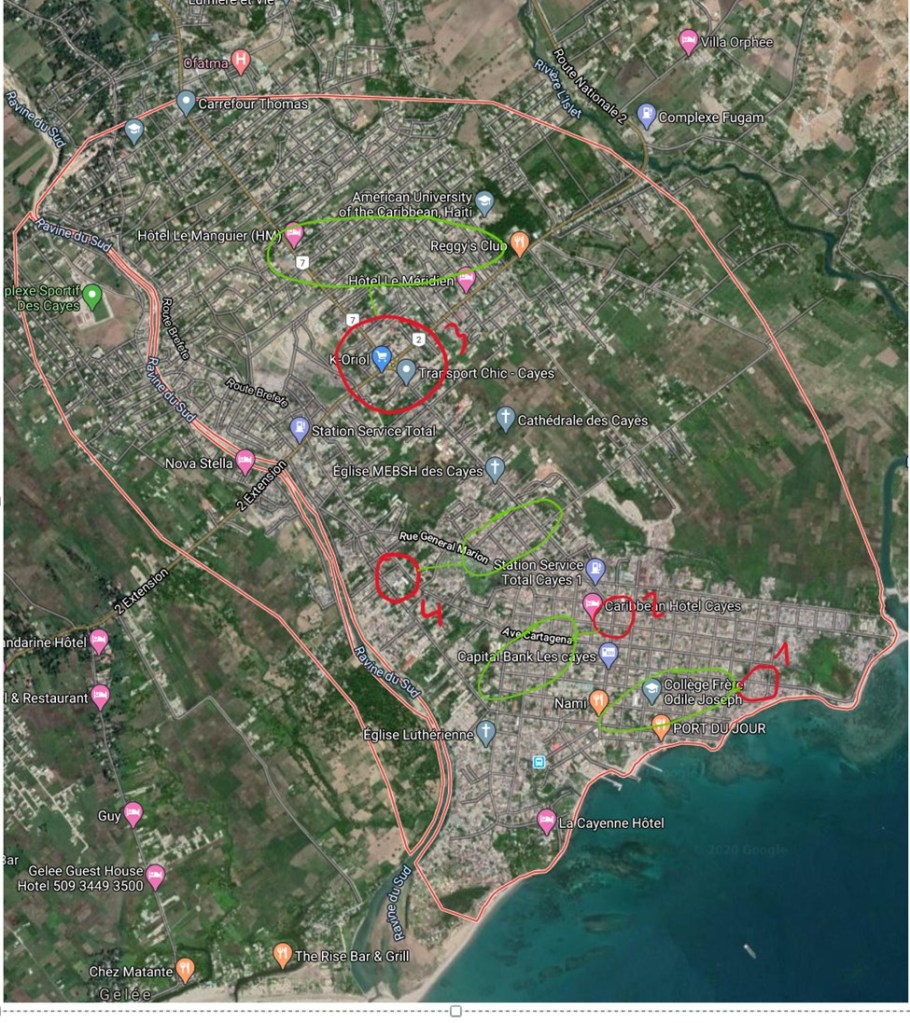
J’avais besoin de 385 répondants pour cette étude. J’ai utilisé la méthode d’échantillonnage aléatoire simple pour m’assurer que chaque habitant de la ville avait une chance d’être inclus dans l’échantillon. La deuxième étape consistait à positionner les enquêteurs dans différents coins de la ville comme présenté ci-dessous.
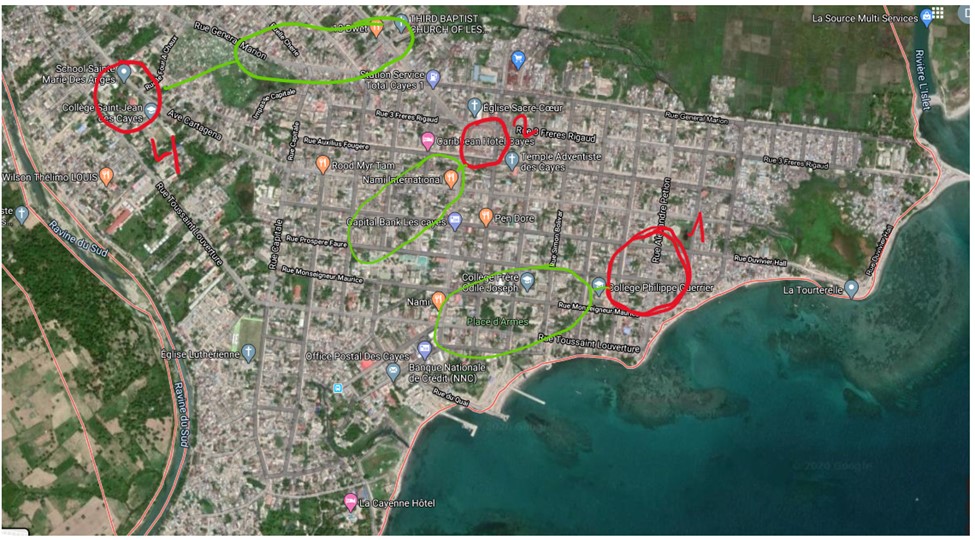
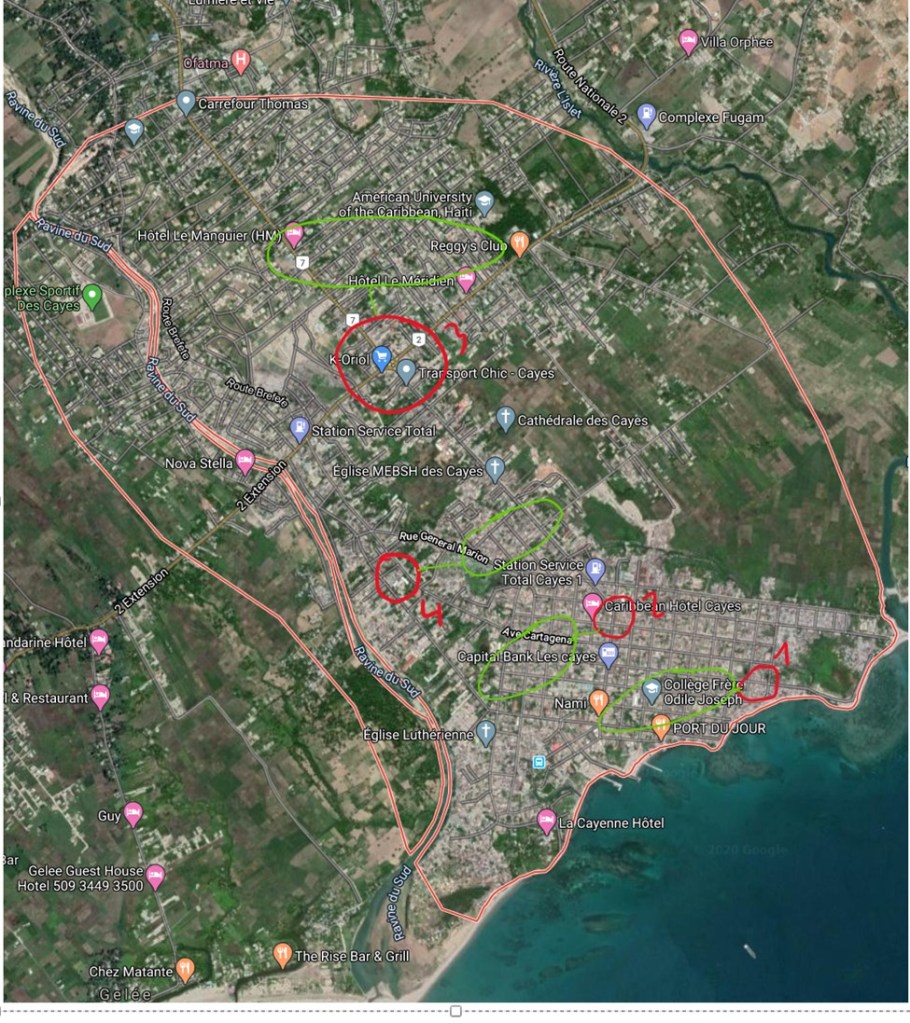
J’ai choisi 4 lieux (en rouge) dans la ville pour poser les questions :
1. La Savanne
2. Les environs du marché principal (Kay fè)
3. Les alentours de la « Croix des Quatre Chemins »
4. Les alentours du « Collège Saint Jean » (Zone tambour)
J’anticipais la présence d’éventuelles valeurs aberrantes dans la collecte de données, donc avec mon équipe, nous avons prévu d’interroger 400 citoyens au lieu de seulement 385. L’objectif était d’interroger des personnes âgées de 20 ans ou plus.
Une équipe d’enquêteurs pour la collecte de données a été constituée dans la ville de Cayes. Il comprenait :
1. Un directeur des opérations.
2. 8 enquêteurs.
Les questions relatives à cette étude sont les suivantes :
“Avez-vous des toilettes à la maison / Quel type de toilettes avez-vous à la maison ?”
« Combien de personnes vivent chez vous ?»
Afin d’assurer la représentativité des échantillons, les enquêteurs ont posé des questions à la première personne qu’ils ont rencontrée. Chaque enquête est menée à au moins une minute d’intervalle.
Pour examiner les types de toilettes auxquelles les gens ont accès, j’ai entré toutes les données sous une variable intitulée « Toilette » et les entrées sont « Ijyenik », « Latrin », « L / I » (pour Latrin et Ijyenik) et « None ». Bien qu’ayant interrogé 404 citoyens, certains répondants n’ont pas mentionné ou ont refusé de mentionner les types de toilettes auxquels ils ont accès. Par conséquent, j’ai procédé à la suppression du total de 3 observations de l’ensemble de données. Dans ce cas, notre variable « Toilette » est catégorique et nominale et comprend 401 observations. La première étape de cette analyse a consisté à créer un tableau des proportions et à effectuer un test d’hypothèse sur la proportion de la population ayant accès à des toilettes avec chasse d’eau.
La deuxième étape de cette analyse comprend également un tableau des proportions et des dénombrements, suivi d’un test d’hypothèse pour déterminer les intervalles de confiance.
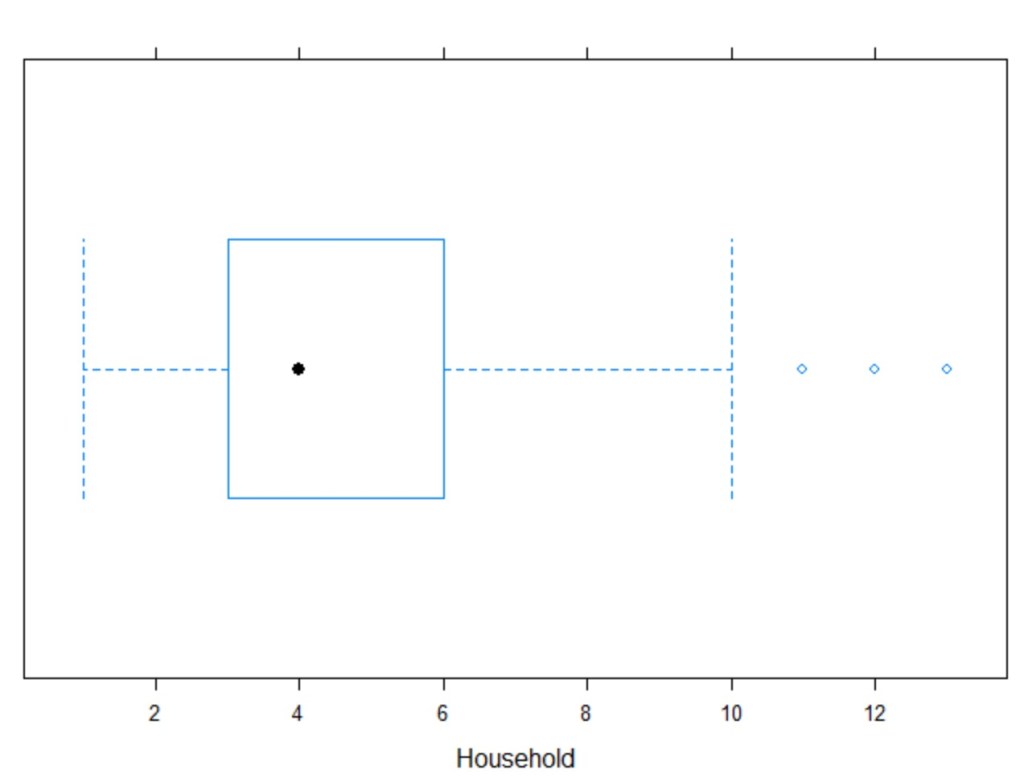
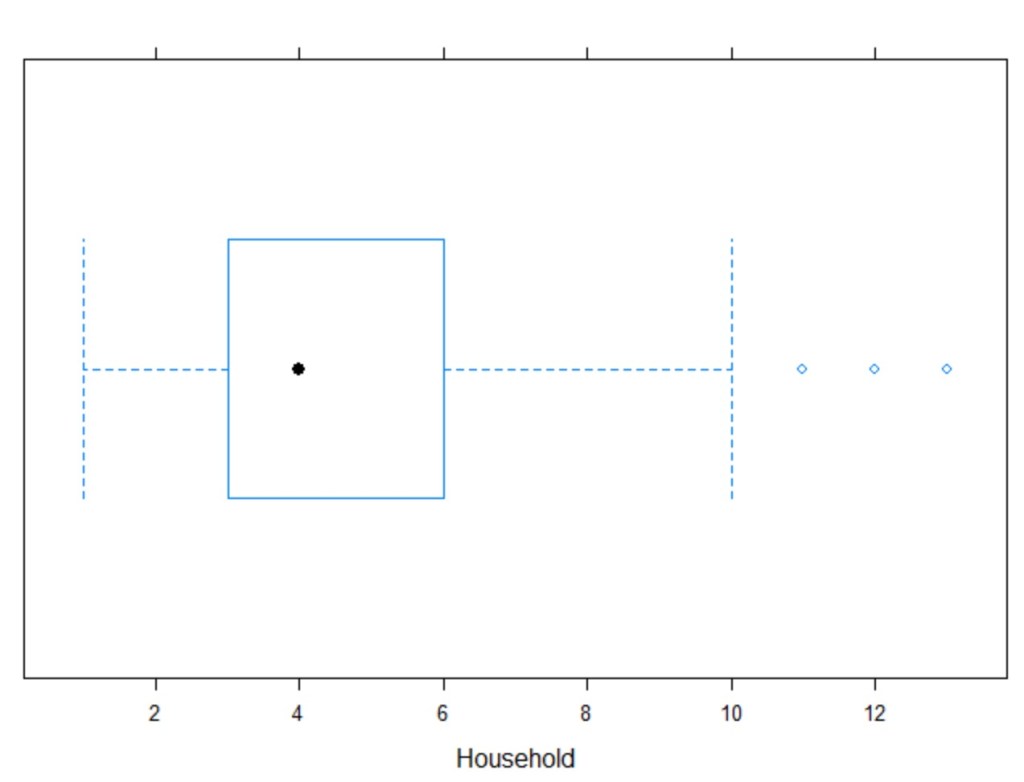
Dans la troisième étape de cette analyse, j’ai procédé à la détermination du nombre moyen de personnes vivant dans un ménage, j’ai saisi les données sous une variable intitulée « Ménage ». Cette variable comprend 401 observations numériques et discrètes. J’ai examiné les données pour les valeurs aberrantes à l’aide d’un diagramme en boîte (voir figure 1) afin de m’assurer que certains répondants n’exagéraient pas le nombre de personnes vivant dans leur ménage. Certaines valeurs aberrantes étaient présentes, mais comme nous supposons que la distribution dans la population est normale et que la taille de notre échantillon est assez importante (> 30), les 3 valeurs aberrantes ont été laissées dans l’ensemble de données. En 2015, la population des Cayes était estimée à environ 86 780 personnes, on sait donc que cet échantillon représente moins de 10% de la population et est donc indépendant. Notre ensemble de données final comprend 2 variables et 401 observations.
Figure 1
Résultats
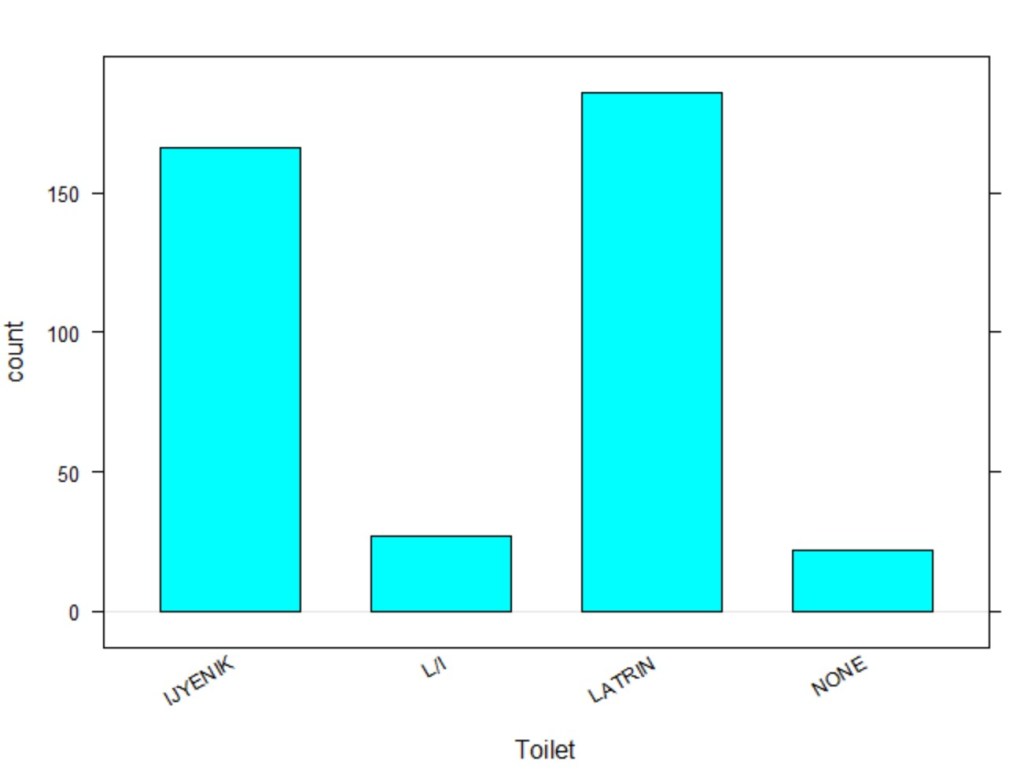
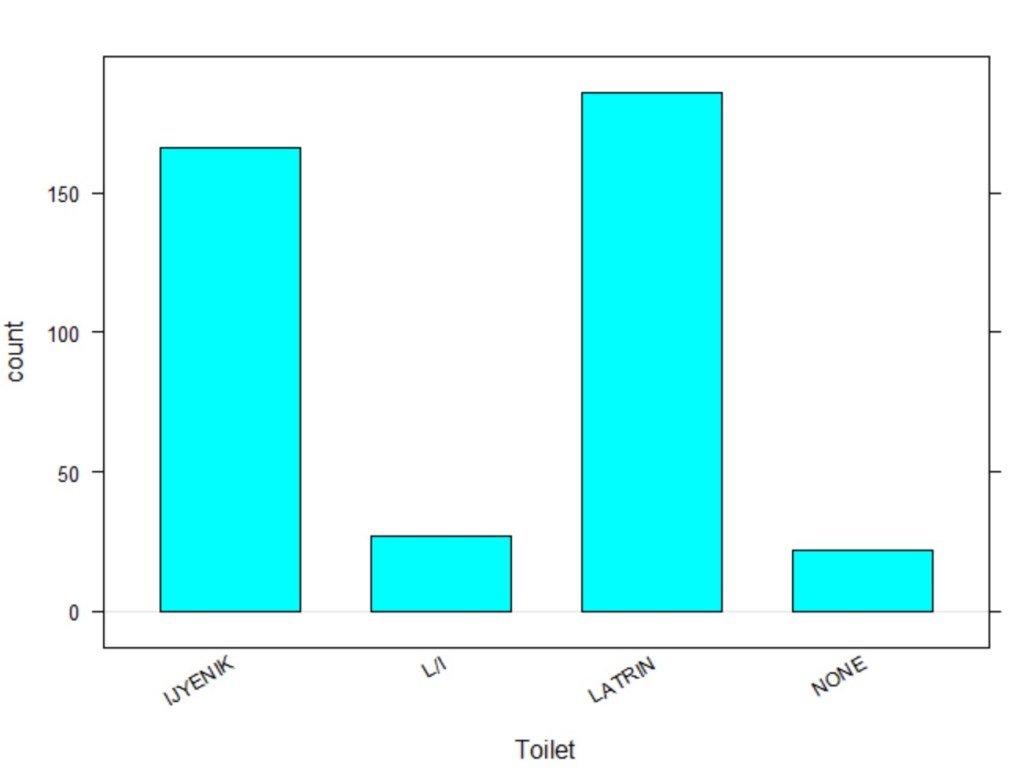
À l’aide d’un logiciel statistique, j’ai calculé et observé qu’environ 46% des personnes interrogées déclaraient avoir accès à des latrines, 41% affirmaient avoir des toilettes à chasse d’eau à la maison, environ 7% affirmaient avoir des latrines et des toilettes à chasse d’eau et 5% déclaraient n’avoir aucune toilette à la maison (voir la figure 2). J’ai également créé un graphique à barres des décomptes afin de visualiser l’importance de chaque entrée. (Voir la figure 3)
Figure 2
Figure 3
Maintenant que j’ai calculé les proportions à partir d’un échantillon aléatoire, je me suis demandé si les nombres trouvés ci-dessus étaient simplement dus à la variabilité d’échantillonnage. Je comprends que si je calculais à plusieurs reprises les proportions à partir de plusieurs échantillons aléatoires, il est possible que je puisse obtenir des résultats différents de ceux que j’ai trouvés ci-dessus. Je veux savoir si la proportion de personnes qui disent avoir accès à des toilettes à chasse d’eau est la même que dans la population. Pour ce faire, j’ai effectué un test de proportions à 1 échantillon sans correction de continuité afin de trouver un intervalle de confiance et de trouver une estimation de la vraie proportion.
Pour mener un tel test, j’ai commencé par énoncer mes deux hypothèses : l’hypothèse nulle (Ho) et l’hypothèse alternative (Ha).
Ho : La proportion de personnes dans la population ayant accès à des toilettes avec chasse d’eau est de 0,5.
Ha : La proportion de personnes dans la population ayant accès à des toilettes avec chasse d’eau n’est pas de 0,5.
L’hypothèse nulle suppose qu’environ la moitié de la population a accès à des toilettes avec chasse d’eau. L’hypothèse alternative suppose que la vraie proportion de la population ayant accès à des toilettes avec chasse d’eau n’est pas de 0,5. En utilisant α = 0,05 comme critère de signification statistique, je rejetterai les hypothèses nulles (Ho) si la valeur p est inférieure à nos critères 0,05
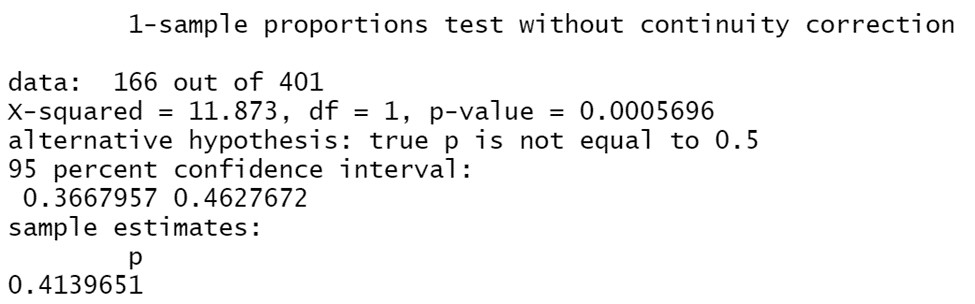
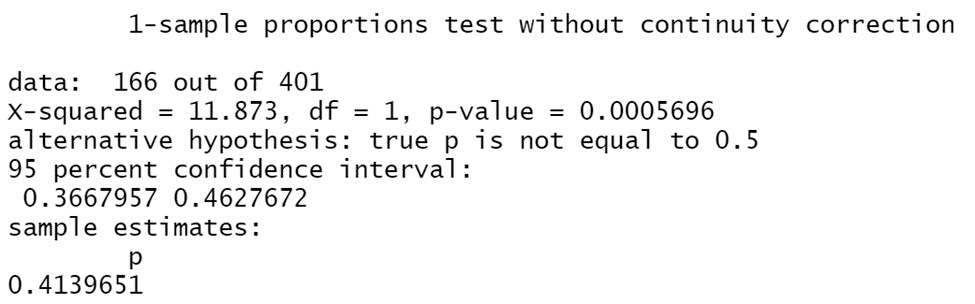
À l’aide d’un logiciel statistique, j’ai calculé un test de proportions à 1 échantillon sans correction de continuité et j’ai obtenu les résultats ci-dessous (Figure 4).
Sur la base des résultats, valeur P = 0,0005696 (inférieure à α = 0,05), je rejette l’hypothèse nulle selon laquelle la vraie partie de la population ayant accès à des toilettes avec chasse d’eau est égale à 0,5. Sur la base de l’intervalle de confiance, je suis convaincu à 95% que la vraie partie de la population possédant des toilettes avec chasse d’eau se situe entre 0,367 et 0,463. En d’autres termes, il est très plausible que la vraie partie de la population ayant accès à des toilettes avec chasse d’eau soit de 0,41 (environ 41%).
Figure 4
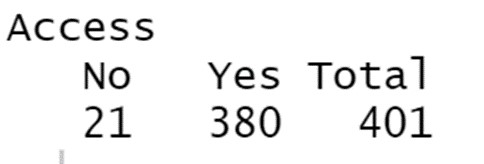
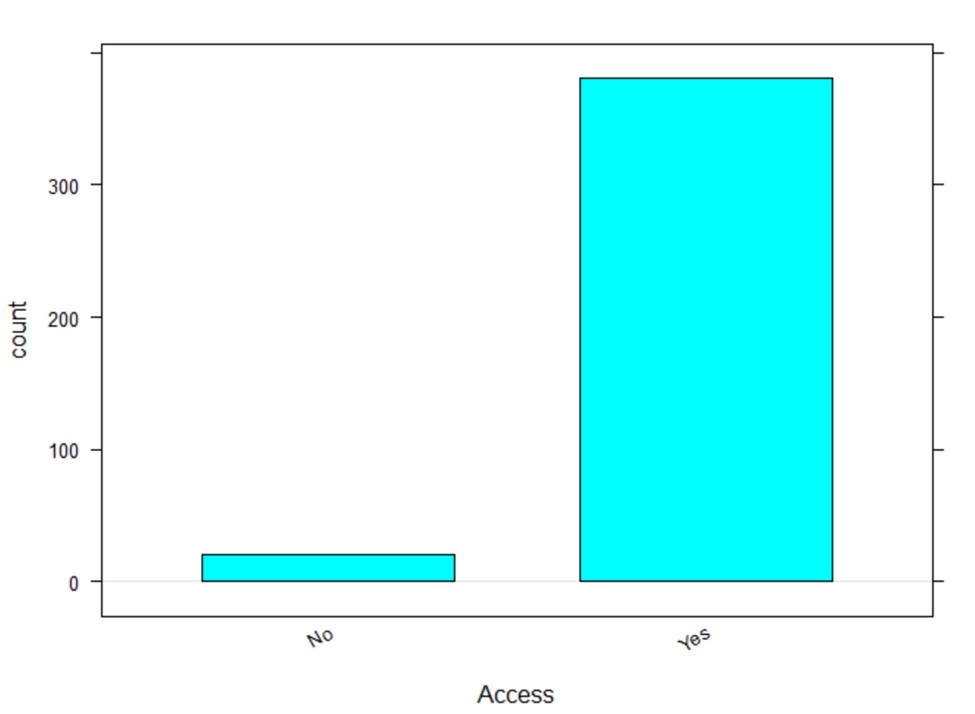
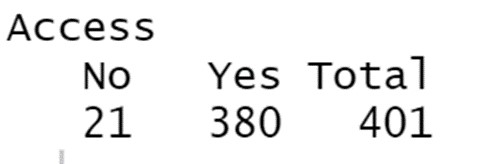
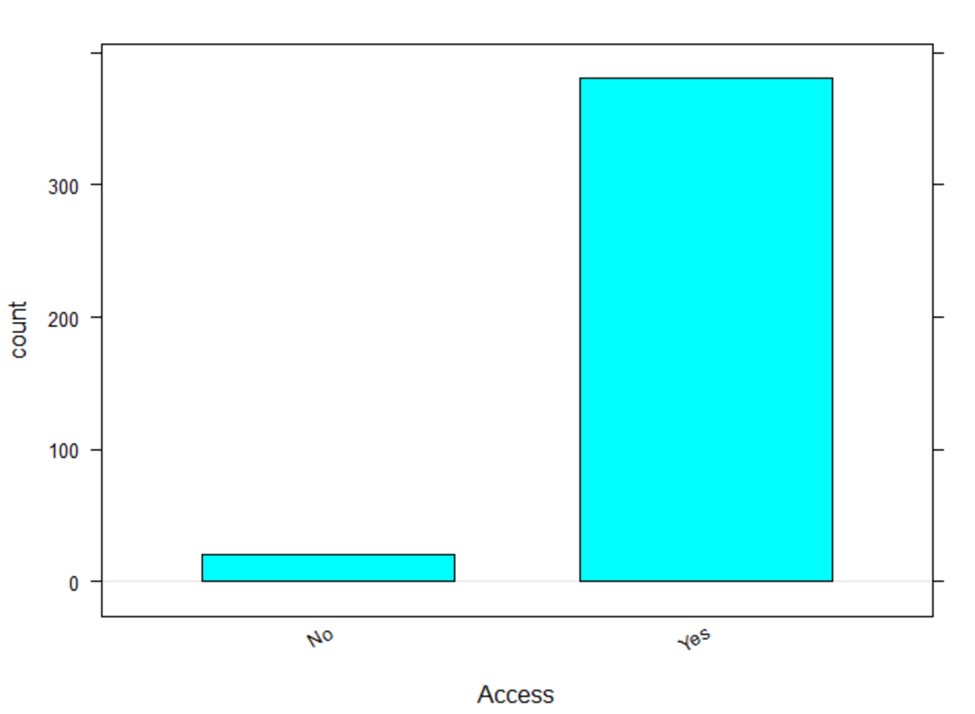
Je devais aussi comparer le nombre de personnes ayant accès aux toilettes à celles qui n’y ont pas accès. J’ai créé un tableau des dénombrements (Figure 5) et un tableau des proportions (Figure 6) et j’ai constaté que dans mon échantillon, environ 95% des répondants affirmaient avoir accès à des toilettes à la maison tandis que 5% affirment ne pas avoir de toilettes du tout. J’ai créé un graphique à barres pour montrer la différence entre le groupe avec accès et celui sans accès (figure 7).
Figure 5
Figure 6
Figure 7
En raison de la variabilité possible de l’échantillonnage, il est important que je réalise un test d’hypothèse et que je détermine un intervalle de confiance. Pour ce faire, j’ai effectué un test z à une proportion.
Pour effectuer le test, j’ai commencé par énoncer mes deux hypothèses : l’hypothèse nulle (Ho) et l’hypothèse alternative (Ha).
Ho : La proportion de personnes ayant accès aux toilettes dans la population est de 0,5
Ha : la proportion de personnes ayant accès aux toilettes dans la population n’est pas de 0,5
L’hypothèse nulle suppose que 50% de la population ont accès aux toilettes tandis que l’hypothèse alternative suppose que la proportion de la population sans accès aux toilettes n’est pas égale à 50%.
J’utilise α = 0,05 comme critère de signification statistique. Il est important de mentionner ici que je rejetterai l’hypothèses nulle (Ho) si la valeur de p est inférieure à nos critères 0,05.
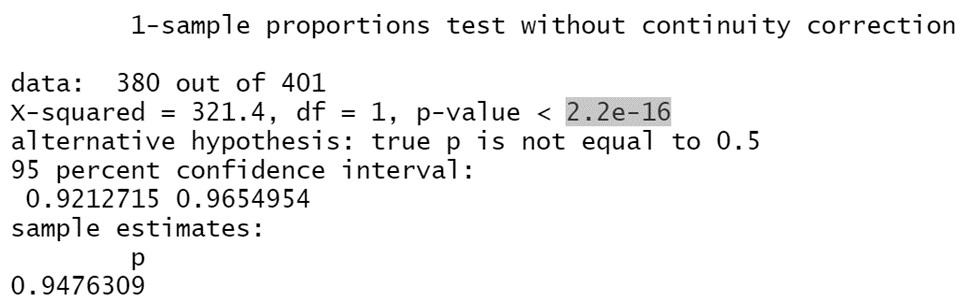
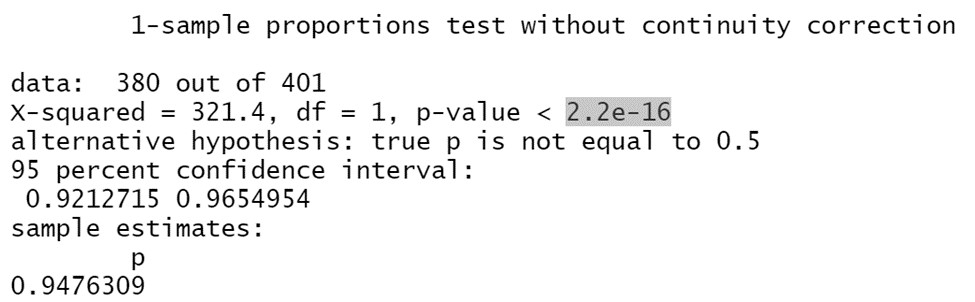
À l’aide d’un logiciel statistique, j’ai effectué un test de proportions d’un échantillon et j’ai obtenu les résultats ci-dessous (Figure 8).
Figure 8
Sur la base des résultats, valeur P <2,2e-16 (inférieure à α = 0,05), je rejette l’hypothèse nulle que la proportion de la population ayant accès aux toilettes est de 50%. Basé sur l’intervalle de confiance. Je suis convaincu à 95% que la vraie proportion de la population ayant accès aux toilettes se situe entre 0,92 et 0,97. En d’autres termes, la vraie proportion pourrait être de 0,95 dans la population.
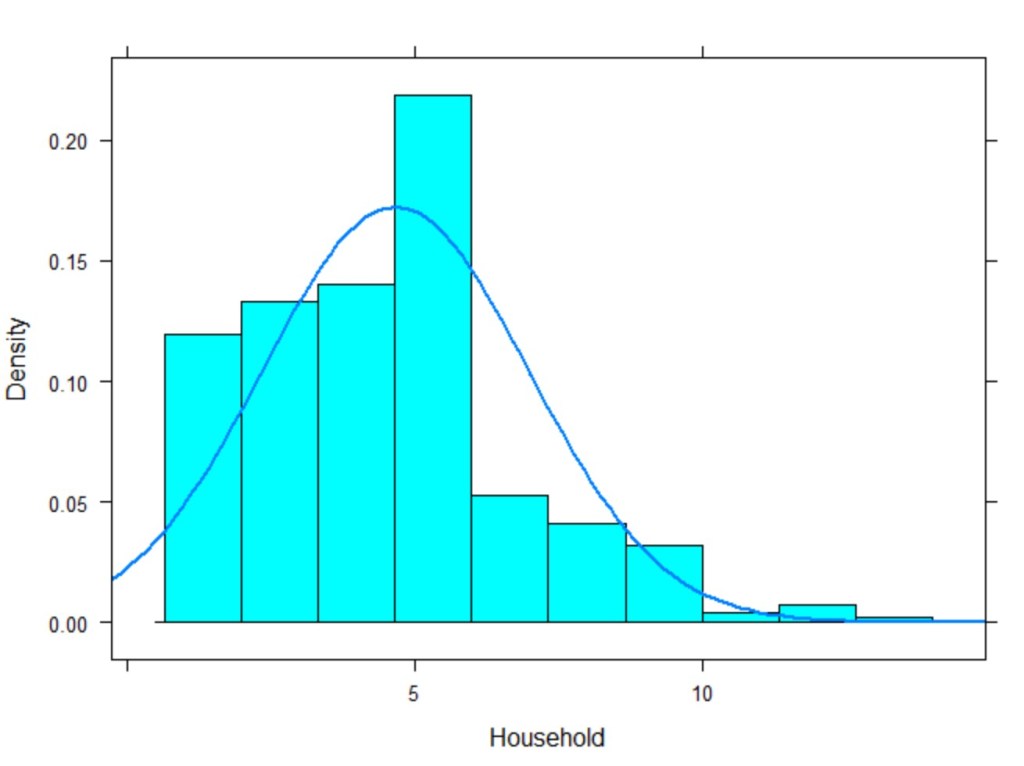
Dans cette étude, j’avais également besoin de trouver le nombre moyen de personnes vivant dans chaque ménage de la ville des Cayes. Ma première action a été de rechercher des statistiques préférées à l’aide d’un logiciel statistique (Figure 9). Les résultats montrent que dans mon échantillon, le nombre moyen de personnes vivant dans un ménage est de 4,67.
Figure 9
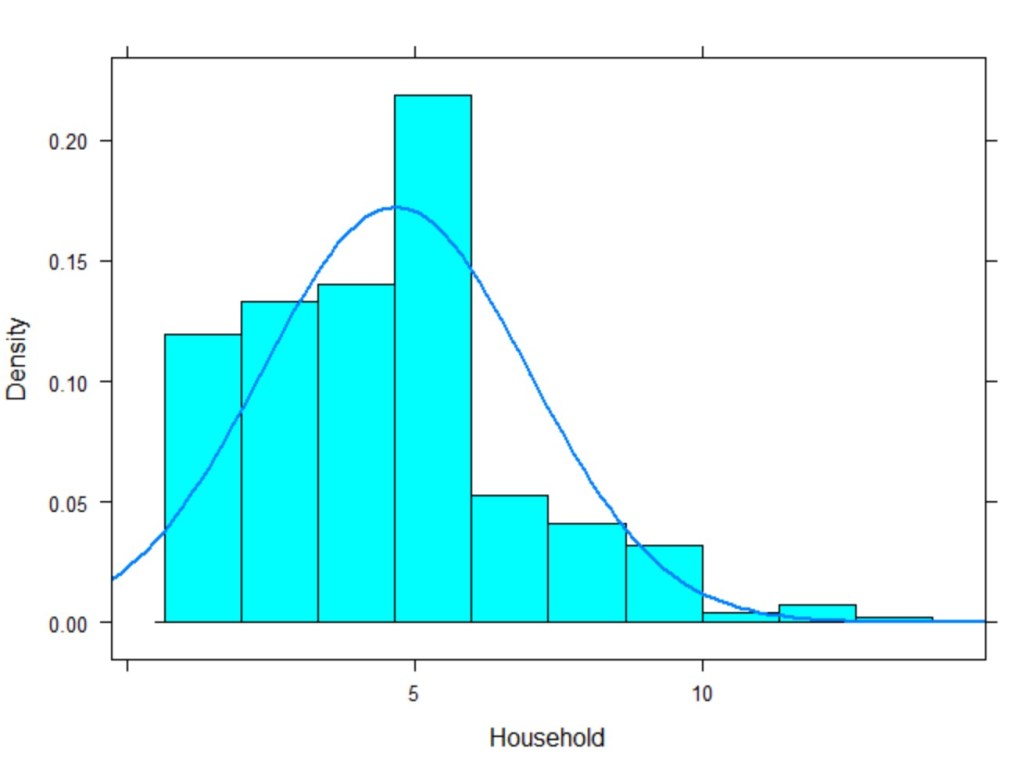
Je sais qu’il est possible que ce résultat soit basé sur la variabilité d’échantillonnage, par conséquent, je devrai effectuer un test d’hypothèse et trouver un intervalle de confiance. Je fais l’hypothèse que cette variable est normalement distribuée dans la population. Dans mon échantillon, la distribution présente une certaine asymétrie positive, mais en raison de la taille de mon échantillon, cela peut être ignoré (Figure 10).
Figure 10
Pour mener un tel test, j’ai commencé par énoncer mes deux hypothèses : l’hypothèse nulle (Ho) et l’hypothèse alternative (Ha).
Ho : Le nombre moyen de personnes dans un ménage dans la population est de 4,67
Ha : Le nombre moyen de personnes dans un ménage dans la population n’est pas de 4,67.
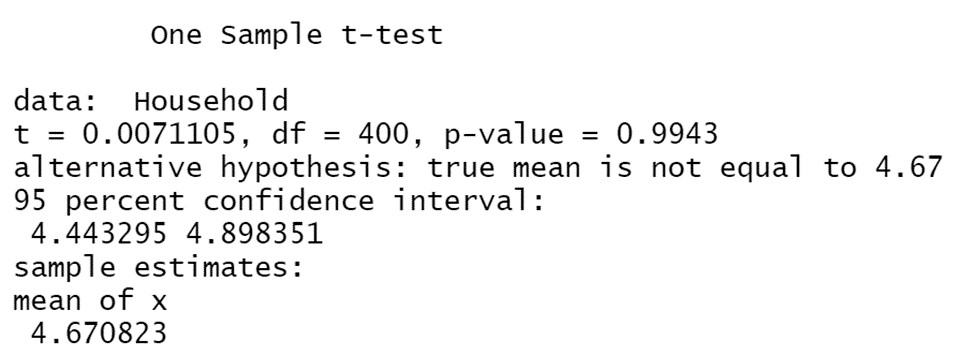
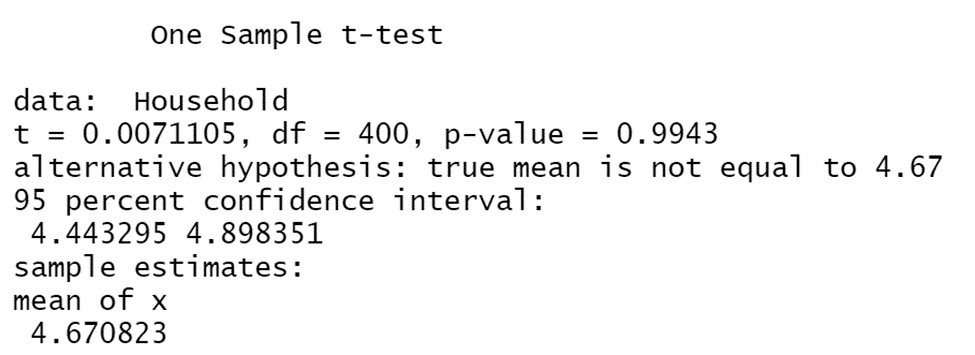
À l’aide d’un logiciel statistique, j’ai calculé la statistique du test t et j’ai obtenu les résultats ci-dessous (Figure 11).
Figure 11
Sur la base des résultats, valeur P = 0,99 (supérieure à α = 0,05), je n’ai pas réussi à rejeter l’hypothèse nulle selon laquelle la vraie moyenne du nombre de personnes dans un ménage dans la population est de 4,67. Sur la base de l’intervalle de confiance, je suis sûr à 95% que le vrai nombre moyen de personnes dans un ménage aux Cayes se situe entre 4,44 et 4,90.
Conclusion
Dans cette étude, je voulais savoir s’il y avait un problème de toilettes aux Cayes. J’ai entrepris d’étudier la proportion de la population ayant accès à des toilettes à chasse d’eau, la proportion de la population ayant accès aux toilettes et le nombre moyen de personnes dans un ménage. Après m’être débarrassé de certaines observations avec des informations manquantes, je me suis retrouvé avec 2 variables et 401 observations. J’ai procédé à la création d’un tableau des proportions du type de toilettes auxquelles les gens ont accès et j’ai effectué un test d’hypothèse. Sur la base de l’intervalle de confiance, j’ai pu dire que je suis convaincu à 95% que la vraie proportion de la population ayant accès à des toilettes avec chasse d’eau se situe entre 0,37 et 0,46. Cela m’a conduit à la conclusion qu’un peu moins de la moitié de la population a accès à des toilettes à chasse d’eau ce qui explique aussi l’inquiétude du futur maire des Cayes.
J’ai également étudié la proportion de la population ayant accès aux toilettes. J’ai créé un tableau de dénombrement et un tableau de proportions et effectué un test d’hypothèse. Je suis en mesure d’affirmer que je suis sûr à 95% qu’entre 0,92 et 0,96 de la population des Cayes ont accès à des toilettes. Ce résultat n’a pas permis d’expliquer l’observation selon laquelle les gens défèquent sur les plages. Il se peut que les gens qui le font ne soient pas de la ville, qu’ils fassent partie des 5% de la population qui n’ont pas accès aux toilettes ou simplement que les gens n’ont pas la possibilité de rentrer chez eux lorsqu’ils ont besoin de déféquer.
Gardant à l’esprit la promesse du maire de se débarrasser des latrines, j’ai calculé les statistiques préférées de mon échantillon pour le nombre de personnes vivant dans un ménage. J’ai également effectué un test d’hypothèse et je suis en mesure de dire que je suis convaincu à 95% qu’entre 4,44 et 4,90 personnes vivent dans un ménage aux Cayes. Si j’estime le nombre de personnes vivant aux Cayes à environ 92 287 personnes et la proportion de personnes ayant accès aux toilettes à chasse d’eau à environ 41%. Le maire devrait aider 59% de la population (54 508 personnes) à avoir accès à des toilettes modernes. Si le nombre moyen de personnes vivant dans un ménage est de 4,67, la promesse du maire concerne environ 11 697 ménages.
Je crois qu’il est important de souligner certaines limites de cette étude. Principalement, malgré tous nos tests d’hypothèse, il y a 5% de chances que les moyennes et proportions de notre échantillon ne correspondent pas aux vraies moyennes et proportions de la population. De plus, comme les affirmations n’ont pas été vérifiées lors de notre enquête, il est toujours possible que les répondants n’aient pas indiqué avec précision le type de toilettes qu’ils ont à la maison ou s’ils en ont. Les toilettes peuvent être un sujet très sensible, mais nous nous attendons à ce que la taille de notre échantillon compense la possibilité de fausse déclaration. Des recherches plus approfondies pourraient examiner de plus près comment les toilettes de la ville pourraient être modernisées et comment d’avantage de toilettes publiques pourraient freiner la défécation en plein air.
Based on the presence of individuals defecating on the beaches of les Cayes and the mayoral candidate (Fortuné) assertion that all latrines should be replaced with flushing toilets, I set out to find if there is a toilet problem in the city of les Cayes. For this paper, I conducted a survey in the city of les Cayes in august 2020, proceeded to observe the count and proportion data, created a bar graph for counts of the types of toilets available and ran a hypothesis test on the proportion of flushing toilets in the general population. I also created a bar graph and observed the count and proportion data before I created a hypothesis test on the proportion of the population with no access to toilets. Finally, I created a histogram for the number of people living in a household and calculated the mean. I also conducted a hypothesis test for the mean number of people in each household. I came to the conclusion that about 41% of the population of les Cayes have access to flushing toilets. Through further hypothesis testing, I am able to say that about 95% of the population in les Cayes have no access to toilets at all. Finally, through the hypothesis testing, I am 95% confident that the true number of people composing a household in Les Cayes is between 4 and 5 (4.67).
Introduction
The city of Les Cayes lies in the southern department of Haiti. I estimate that about 92,387 people live in the city today. In the city of les Cayes, it is not uncommon to see people defecate by the beach. Also, in 2016, the future mayor of Les Cayes promised to replace all latrines in the city with flushing toilets. Recently, Haiti faced a cholera pandemic that killed thousands hence, it is understandable that the subject of modern toilets has taken a front seat in the general debates. These two observations led me to question the state of toilets in the city of Les Cayes. In this paper, I intend to find out how many people have access to flushing toilets, how many people have access to toilets in general and how many people live on average in a house in Les Cayes.
Data and Methods
For this study, I wanted a confidence level of 95%, a standard deviation of 0.5, and a margin of error (confidence interval) of +/- 5%. Hence, I calculated the sample size using the following formula: Required Sample Size = ((0.5) ² × (0.5) × (1-0.5)) / ((0.05) ²). Therefore, Required Sample Size = 385 respondents.
I needed 385 respondents for this study. I used the simple random sample method to ensure that every inhabitant of the city has a chance of being included in the sample. The second step was to position the investigators in various corners of the city as presented below.
I chose 4 places (in red) in the city to ask the questions:
1. La Savanne
2. The surroundings of the main market (Kay fè)
3. The surroundings of the “Croix des quatres Chemins”
4. The surroundings of “college Saint Jean” (Drum Zone)
I anticipated the presence of possibility outliers in the data collection, so with my team, we planned to interview 400 citizens instead of just 383. The goal was to interview people aged 20 or older.
A team of investigators for data collection was formed in the town of Cayes. It included:
1. An Operations Manager.
2. 8 investigators.
The questions pertaining to this study are the following:
“Do you have a toilet at home/ What type of toilet do you have at home?”
“How many people can live at your house?”
In order to ensure the representativeness of the samples, investigators asked questions to the first person they see. Each survey is conducted at least one minute apart.
To examine the types of toilets that people have access to, I entered all the data under a variable entitled “Toilet” and the entries are “Ijyenik”, “Latrin”, L/I (for Latrin and Ijyenik) and “None”. Despite having questioned 404 citizens, some respondents failed to mention or refused to mention which types of toilets they have access to. Hence, I proceeded to remove total of 3 observations the dataset. In this instance, our variable “Toilet” is categorical and nominal and consists of 401 observations. The first step in this analysis was to create a table of proportions and conduct a hypothesis test for the proportion of the population with access to flushing toilets.
The second step in this analysis also included a table of proportions and of counts, followed by a hypothesis test to determine confidence intervals.
In the third step of this analysis, I proceeded to determine the average number of people living in a household, I entered the data under a variable entitled “Household”. This variable consists of 401 observations that are numerical and discrete. I examined the data for outliers using a boxplot (see figure 1) in order to make sure that some respondents did not over or under exaggerate the number of people living in their household. Some outliers were present but because we assume that the distribution in the population is normal due and the size of our sample is quite important (>30), the 3 outliers were left in the data set. In 2015, the population of Les Cayes was estimated to be around 86,780 people so we know that this sample represents less than 10% of the population and is therefore independent. Our final data set is comprised of 2 variables and 401 observations.
Using Statistical software, I calculated and observed that about 46% of respondents claimed to have access to latrines, 41 % claimed they had flushing toilets at home, about 7 % claimed to have latrines and flushing toilets and 5% reported having no toilets at all at home (See Figure 2). I also created a bar graph of counts in order to visualize the importance of each entry. (See Figure 3)
Now that I calculated the proportions from a random sample, I wondered if the numbers found above are just due to sampling variability. I understand that if I repeatedly calculated the proportions from several random samples, it is possible that I could get results that vary from the ones I found above. I want to know if the proportion of people who say they have access to flushing toilets is the same as in the population. To do so I conducted a 1-sample proportions test without continuity correction in order to find a confidence interval and find an estimate of the true proportion.
To conduct such a test, I began by stating my two hypotheses: the null hypothesis (Ho) and the
Ha: The proportion of people in the population with access to flushing toilets is not 0.5.
The null hypothesis assumes that about half of the population have access to flushing toilets. The alternative hypothesis assumes that the true proportion of the population with access to flushing toilets is not 0.5. Using a α=0.05 as the criteria for statistical significance, I will reject the null hypotheses (Ho) if the p-value is less than our criteria 0.05
Using statistical software, I computed a 1-sample proportions test without continuity correction and got the results below (Figure 4).
Based on the results, P-value= 0.0005696 (Lower than α=0.05), I reject the null hypothesis that the true portion of the population with access to flushing toilets is equal to 0.5. Based on the confidence interval, I am 95% confident that the true portion of the population with flushing toilets is between 0.367 and 0.463. In other words, it ss very plausible that the true portion of the population with access to flushing toilets is 0.41 (about 41%).
I also needed to compare the number of people with access to toilets to those who don’t have any access. I created a table of counts (Figure 5) and a table of proportions (Figure 6) and found that in my sample, about 95 % of respondents claimed to have access to a toilet at home while 5 % assert not having any toilets at all. I created a bar graph to show the difference between the group with access and the one with no access (figure 7).
Because of possible sampling variability it is important that I conduct a hypothesis test and determine a confidence interval. To do so, I conducted a one proportion z test.
To conduct the test, I began by stating my two hypotheses: the null hypothesis (Ho) and the
alternative hypothesis (Ha).
Ho: The proportion of people with access to toilets in the population is 0.5
Ha: The proportion of people with access to toilets in the population is not 0.5
The null hypothesis assumes that 50% of the population have access to toilets while the alternative hypothesis assumes that the proportion of the population with no access to toilets is not equal to 50%.
I am using α=0.05 as the criteria for statistical significance. It is important to mention here that I
will reject the null hypothesis (Ho) if the p-value is less than our criteria 0.05.
Using Statistical software, I conducted a 1 sample proportions test and got the results below (Figure 8)
Based on the results, P-value< 2.2e-16 (lower than α=0.05), I reject the null hypothesis that the proportion of the population with access to toilets is 50%. Based on the confidence interval. I am 95% confident that the true proportion of the population with access to toilets is between 0.92 and 0.97. In other words, the true proportion could be 0.95 in the population.
In this study, I also needed to find the average number of people living in each household in the city of Les Cayes. My first action was to look up favorite statistics using statistical software (Figure 9). The results show that in my sample, the average number of people living in a household is 4.67.
Figure 9
I know that there is a possibility that this result is based on sampling variability hence, I will have to conduct a hypothesis test and find a confidence interval. I am making the assumption that this variable is normally distributed in the population. In my sample, the distribution has some positive skew but due to the size of my sample, that can be disregarded (Figure 10)
Based on the results, P-value= 0.99 (greater than α=0.05), I failed to reject the null hypothesis that the true average of number of people in a household in the in population is 4.67. Based on the confidence interval, I am 95% confident that the true average number of people in a household in Les Cayes is between 4.44 and 4.90.
Conclusion
In this study, I wanted to find out if there was a toilet problem in les Cayes. I set out to investigate the proportion of the population with access to flushing toilets, the proportion of the population with access to toilets and the average number of people in a household. After getting rid of some observations with missing information, I was left with 2 variables and 401 observations. I proceeded to create a table of proportions for the type of toilets people have access to and conducted a hypothesis test. Based on the confidence interval, I was able to say that I am 95% confident that the true proportion of the population with access to flushing toilets is between 0.37 and 0.46. This led me to the conclusion that a little less than half of the population have access to flushing toilets which also explains the concern of the future mayor of les Cayes.
I also studied the proportion of the population with access to toilets. I created a table of counts and a table of proportions and conducted a hypothesis test. I am able to affirm that I am 95% confident that between .92 and .96 of the population of les Cayes have access to a toilet. This result failed to explain the observation that people defecate on the beaches. It may be that people who do so are not from the city, that they are part of the 5% of the population that do not have access to toilets or simply that people don’t have the possibility to go home when they need to defecate.
Keeping in mind the promise of the mayor to get rid of latrines, I calculated the favorite statistics of my sample for the number of people living in a household. I also conducted a hypothesis test and I am able to say that I am 95% confident that between 4.44 and 4.90 people live in a household in Les Cayes. If I estimate the number of people living in les Cayes to be about 92,287 people and the proportion of people with access to flushing toilets to be about 41%. The mayor would have to help 59% of the population (54,508 people) to gain access to modern toilets. If the average number of people living in a household is 4.67, the mayor’s promise concerns about 11,697 households.
I believe that it is important to point out some limitations of this study. Mainly that despite all our hypothesis testing, there is a 5% chance that our sample means and proportions do not correspond to the true means and proportions of the population. Furthermore, because assertions were not verified during our survey, there is always a possibility that respondents did not accurately report the type of toilets that they have at home or if they have any all. Toilets can be a very sensitive topic but we expect the size of our sample to compensate for the possibility of misreporting. Further research could look more closely at how toilets in the city could be modernized and how more public toilets could curb open air defecation.
 Fondation Ti Ajoupa – Non-Profit Organization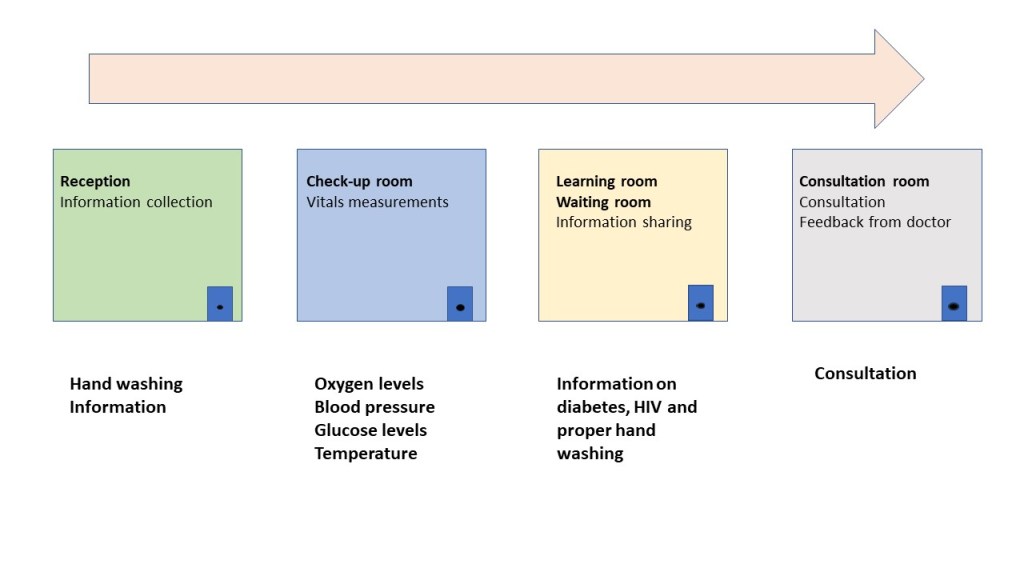






 C.Paribus Management